
Why Tire Pressure Gauges Read Differently: 6 Gauges, 1 Tire, Tested
Last updated:
On the same tire at the same moment, a precision reference gauge read 19.81 PSI and five everyday gauges read between 19.5 and 21.0 PSI, a spread of 1.5 PSI. All five were within the error the international standard allows for tire gauges, so a difference of 1 to 2 PSI between two good gauges is normal. What matters most is using the same gauge every time.
Check a tire with two gauges and you will often get two different numbers. It is easy to think one of them is broken, or that your deflator is off. Usually neither is true. We set up a simple test to show how much everyday gauges differ, and why.
Our Test: Six Gauges on One Tire
To take everything else out of the picture, we fitted one tire with five valve stems. Four gauges were connected at the same time, each to its own valve stem, so they all read the same air at the same moment: no time gap, no temperature change and no air lost between readings. The two press-on gauges were then pressed onto the fifth valve stem, one reading each.
As the reference we used a precision digital gauge with a 0 to 1 MPa (0 to 145 PSI) range and a 0.1 accuracy class, which keeps it within about 0.15 PSI. It read 19.81 PSI.
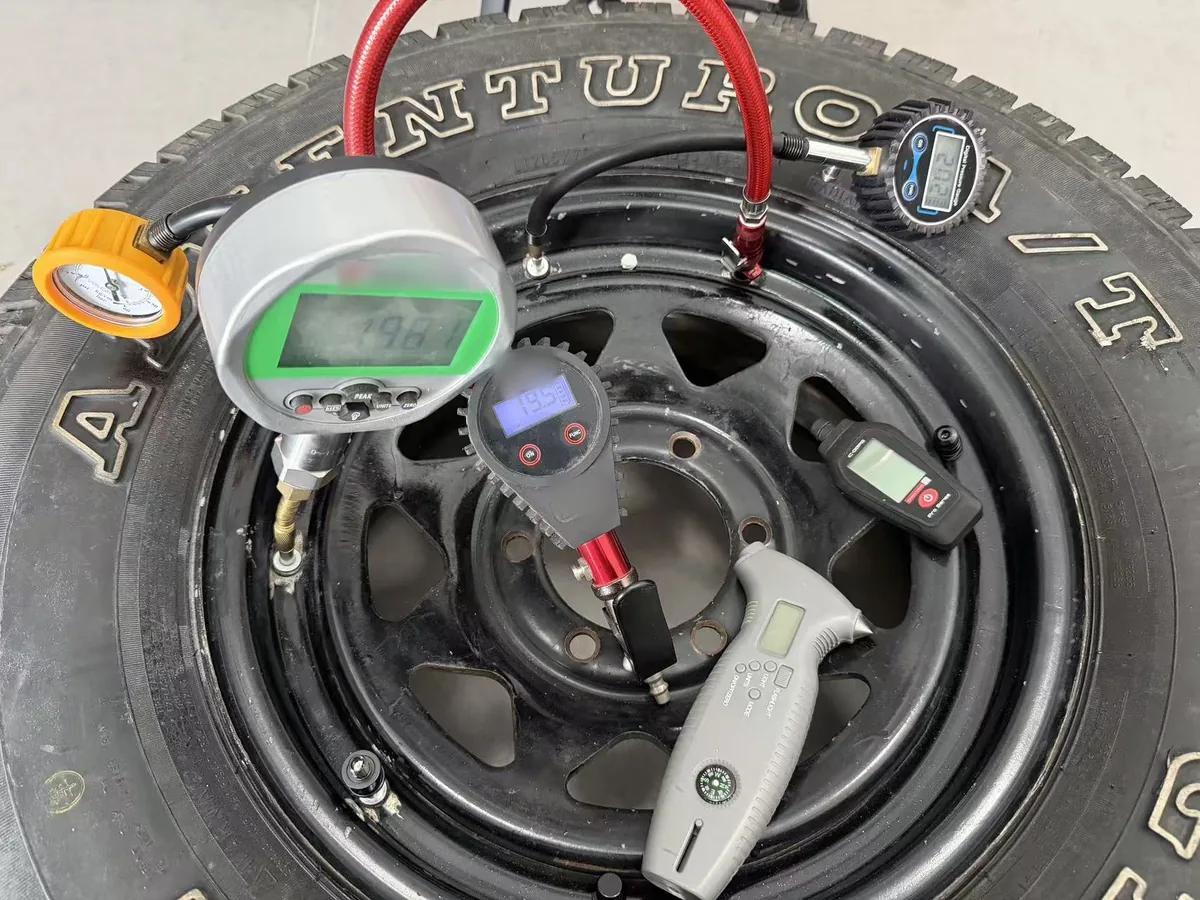
| Gauge | Display steps | Reading | Difference from reference |
|---|---|---|---|
| Precision digital (reference) | 0.01 PSI | 19.81 PSI | - |
| Digital gauge A | 0.5 PSI | 19.5 PSI | -0.31 PSI |
| Digital gauge B | 0.1 PSI | 20.2 PSI | +0.39 PSI |
| Dial gauge | 2 PSI per mark | 20.2 PSI | +0.39 PSI |
| Press-on digital gauge A | 0.1 PSI | 20.0 PSI | +0.19 PSI |
| Press-on digital gauge B | 0.5 PSI | 21.0 PSI | +1.19 PSI |
The five everyday gauges ranged from 19.5 to 21.0 PSI. The largest difference from the reference was 1.19 PSI, and the largest difference between two everyday gauges was 1.5 PSI.
What the Standards Allow
Tire gauges are allowed a small error. The international recommendation for tire pressure gauges, OIML R 23, allows hand-held gauges with a scale up to 4 bar (about 58 PSI) an error of ±0.08 bar (about ±1.2 PSI) when new and ±0.1 bar (about ±1.5 PSI) in service. That error is the same across the whole scale.
Dial gauges are often rated to ASME B40.100, where accuracy is a percentage of the full scale, for example ±2% in the middle of the dial and ±3% at the ends for grade B. On a 0 to 100 PSI dial, ±2% is ±2 PSI, whether you are reading 80 PSI or 15 PSI.
All five everyday gauges in our test were within the OIML limits. Yet two gauges that both pass can still disagree: if one reads 1 PSI high and the other 1 PSI low, they are 2 PSI apart.
Why Gauges Disagree
- Allowed error: every gauge has a tolerance, and two good gauges can sit at opposite ends of it.
- Scale range: when accuracy is a percentage of full scale, a gauge built for 150 PSI is less precise at 15 to 20 PSI than one built for 60 PSI.
- Display steps are not accuracy: a gauge that shows 0.1 PSI steps is not necessarily accurate to 0.1 PSI. It can still be off by up to the error the standard allows.
- Reading a dial: with marks every 2 PSI, anything in between is judged by eye, and the angle you look from changes the reading.
- Press-on technique: if the gauge is not pressed straight onto the valve, a little air escapes and the reading can change from one press to the next.
- Wear and knocks: a gauge that has been dropped, has a weak battery or is getting old can drift.
Digital vs Mechanical Gauges
| Digital | Mechanical (dial or pencil) | |
|---|---|---|
| Reading | Clear numbers, often in 0.1 PSI steps | Read by eye, marks every 1 to 2 PSI |
| Out of the box | Often accurate, but quality varies widely | Varies; cheap dials are often less accurate |
| Weak points | Battery, electronics in the cold, slow drift | Drops and knocks, worn springs, reading angle |
| Needs a battery | Yes | No |
Quality matters more than type. A good digital gauge and a good mechanical gauge will both do the job, and a poor one of either type can be well off.
Outside temperature and altitude have very little effect on the gauge itself. OIML R 23 allows a change of no more than 0.4% of full scale for every 10 degrees C away from room temperature, about 0.2 PSI on a 60 PSI gauge. Extreme cold is the bigger risk: batteries and displays slow down, and rubber seals get stiff. The changes you see in the tire with temperature and altitude are real changes in tire pressure, not gauge error (see What Changes the Right Pressure).
What This Means When You Air Down
- Use the same gauge on all four tires, so the readings can be compared.
- Calibrate your automatic deflators with the gauge you will keep using. The correction you write on each locking cap belongs to that gauge; if you change gauges, check the correction again (see how to calibrate the 1STKIT PRO or 1STKIT Quick Connect).
- Not sure which deflator suits how you air down? Compare them in Types of Tire Deflators.
Frequently Asked Questions
Why do two tire gauges show different readings?
Every gauge has an allowed error. Under OIML R 23, a hand-held tire gauge may be off by about 1.2 PSI when new and 1.5 PSI in service, so two good gauges can differ by 1 to 2 PSI or more. In our test, five everyday gauges on the same tire read 19.5 to 21.0 PSI.
How accurate should a tire pressure gauge be?
Within about 1 to 1.5 PSI is normal for a hand-held gauge. A precision gauge can be within a few tenths of a PSI.
Is a digital or dial tire gauge more accurate?
Neither type is always better. Digital gauges are easier to read and are often accurate, but quality varies. Dial gauges need no battery, but they are read by eye and can be knocked out of calibration. Choose a good-quality gauge and keep using the same one.
Does a 0.1 PSI display mean the gauge is accurate to 0.1 PSI?
No. The display step is how finely the number is shown, not how close it is to the true pressure. A gauge can show 0.1 PSI steps and still be off by more than 1 PSI.
How can I check my tire gauge?
Compare it with a gauge you trust, on the same tire at the same time. If it always reads a little high or low, note the difference and allow for it, or replace the gauge.