
Why One Tire Deflator Per Wheel Is Better: 6 Valve Stems Tested
Last updated:
One deflator per wheel, each calibrated on its own wheel, is better for three reasons: the error is smallest, when one wheel is off you know straight away where to look, and different front and rear pressures are easy. The main reason is the valve stem: in our test, the same deflator at the same 20 PSI setting stopped anywhere from 19.5 to 26 PSI depending on the valve stem.
Set four automatic deflators to the same pressure and the four tires can still end up a few PSI apart, or a deflator that was accurate on one wheel stops high on another. The deflators are often blamed, but the answer is usually in the valve stem. We tested six valve stems with one deflator, cut them open to see why they behave differently, and compared using the deflators on any wheel with keeping one on each wheel.
Our Test: Six Valve Stems, One Deflator
We fitted a 32-inch tire with five valve stems and used one 1STKIT Quick Connect automatic deflator set to 20 PSI. Every run started at 30 PSI, and every result was read with the same gauge. Each valve stem was tested twice. We also tested an original TPMS valve stem on a 35-inch tire.
| Valve stem | Run 1 | Run 2 |
|---|---|---|
| Original valve stem (32-inch tire) | 21.5 PSI | 21.5 PSI |
| Built-in rapid deflation valve | 20.5 PSI | 20.5 PSI |
| TR48E (metal clamp-in) + rapid deflation valve | 20.0 PSI | 21.0 PSI |
| TR48E #1 (metal clamp-in) | 26.0 PSI | 25.0 PSI |
| TR48E #2 (metal clamp-in) | 22.5 PSI | 23.0 PSI |
| Original TPMS valve stem (35-inch tire) | 19.5 PSI | 20.0 PSI |
The same deflator at the same setting left anywhere from 19.5 to 26 PSI, a spread of 6.5 PSI. The two runs on each valve stem were within 1 PSI of each other, so the difference comes from the valve stems, not from the deflator. The readings also include the deflator's own calibration, so compare the valve stems with each other rather than with the 20 PSI setting.
Why Every Valve Stem Is a Little Different
Car and light truck valve stems take a standard valve core, and the international standard ISO 20562 sets the size of the chamber it sits in. Below the seat where the valve core seals, the chamber gets wider: this part, F, is 4.27 to 4.70 mm across.
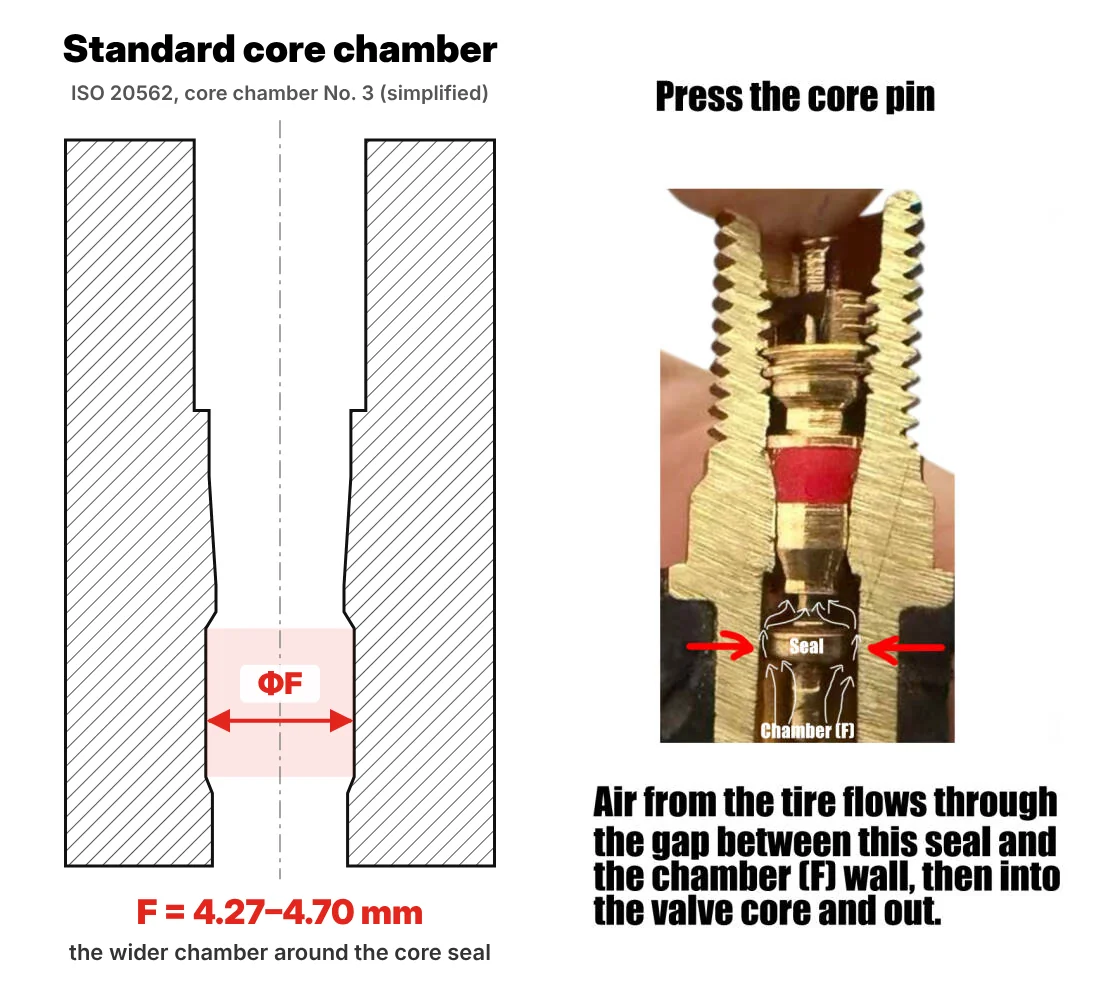
When the pin of the valve core is pressed, the seal at the bottom of the core moves down into the wider chamber (F). Air from the tire flows through the gap between this seal and the chamber wall, then into the valve core and out.
An automatic deflator closes when the pressure at its own end reaches the setting. While air is flowing, a narrow point between the tire and the deflator lowers the pressure the deflator sees, so it closes while the tire is still above the setting. The narrower the gap, the bigger the difference.
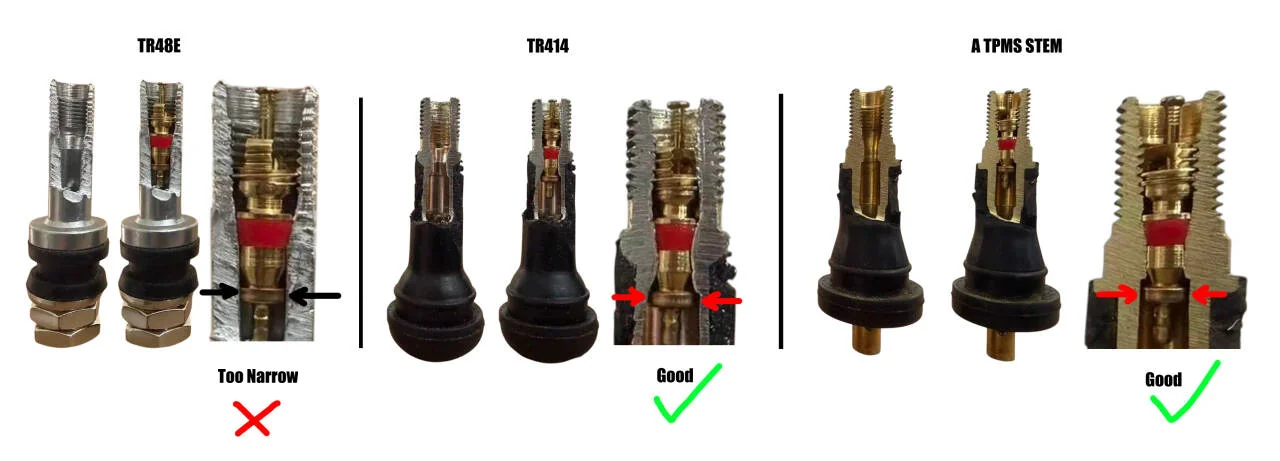
In the TR48E we cut open (#1 in the table), the bore stays at about 3.95 mm below the seat, smaller than the 4.27 mm minimum for F. When the seal moves down, there is almost no gap around it for the air to pass, and the deflator stopped at 25 to 26 PSI. This sample is out of tolerance; the TR414 (a rubber snap-in valve stem) and the TPMS valve stem have the wider chamber with a clear gap around the seal.
Valve stems made to the standard can still differ, because the standard allows a range for F: in our tests, by 0 to 2 PSI. Original valve stems are normally made to the standard (we have not found one out of tolerance so far), yet in our test the original valve stems on the 32-inch and 35-inch tires stopped about 2 PSI apart. An out-of-tolerance valve stem can differ more: TR48E #2 stopped at 22.5 to 23 PSI, about 3 PSI lower than TR48E #1. The model number alone does not tell you how a valve stem will work with an automatic deflator.
One Deflator Per Wheel vs. Using Them on Any Wheel
| Deflators used on any wheel | One deflator per wheel | |
|---|---|---|
| Accuracy | Accurate only on the wheel it was calibrated on; on another valve stem it can be 0 to 2 PSI off | Each deflator is calibrated on its own valve stem, so the error is smallest |
| When one wheel is off | Hard to tell whether the deflator or the valve stem is the cause | Each wheel has a steady result to compare with; swap two deflators to find the cause |
| Different front and rear pressures | Easy to mix up the settings | Front and rear deflators keep their own settings |
| After a drop or cleaning | The correction on the cap may not match the wheel it goes on next | Set it back to the correction on its locking cap |
Finding a problem quickly: with one deflator per wheel, each wheel gives the same result every time. If one wheel suddenly ends higher or lower, swap its deflator with one from another wheel and run them again. If the change stays with the wheel, look at the valve stem and valve core; if it moves with the deflator, check that deflator.
Different front and rear pressures: if you run different pressures front and rear, for example with a loaded rear axle, set the front and rear deflators once and they keep their own settings.
How to Set It Up
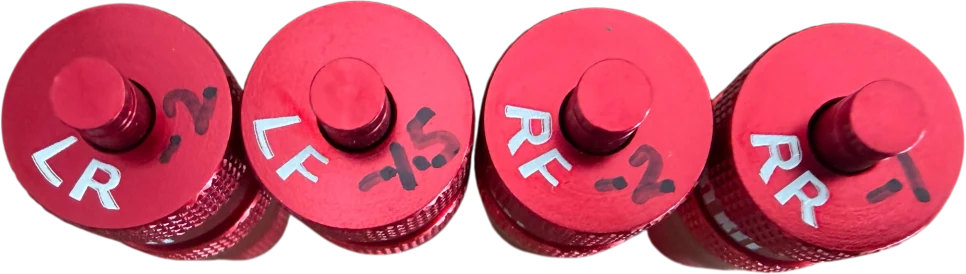
- Mark each deflator for its wheel: LF, RF, LR and RR.
- Calibrate each one on its own wheel and write the correction on its locking cap (see how to calibrate the 1STKIT PRO or 1STKIT Quick Connect).
- If you change a valve stem, a valve core or a valve extension, check the correction again.
- In our tests, of two tires with the same deflator and setting, the one that ends lower usually has the larger chamber F, and a larger chamber F usually gives a steadier result at low settings, such as 10 PSI and below.
- If your gauge reads more than 5 PSI above the setting when you calibrate (a correction beyond -5), check how steady the results are at low settings, or contact us.
If You Use Valve Extensions
- Remove the valve core from the original valve stem. With two valve cores in a row, the air has to pass two narrow points: in our test, the deflator stopped 4 to 6 PSI high, and at low settings such as 10 PSI the result varied a lot from run to run.
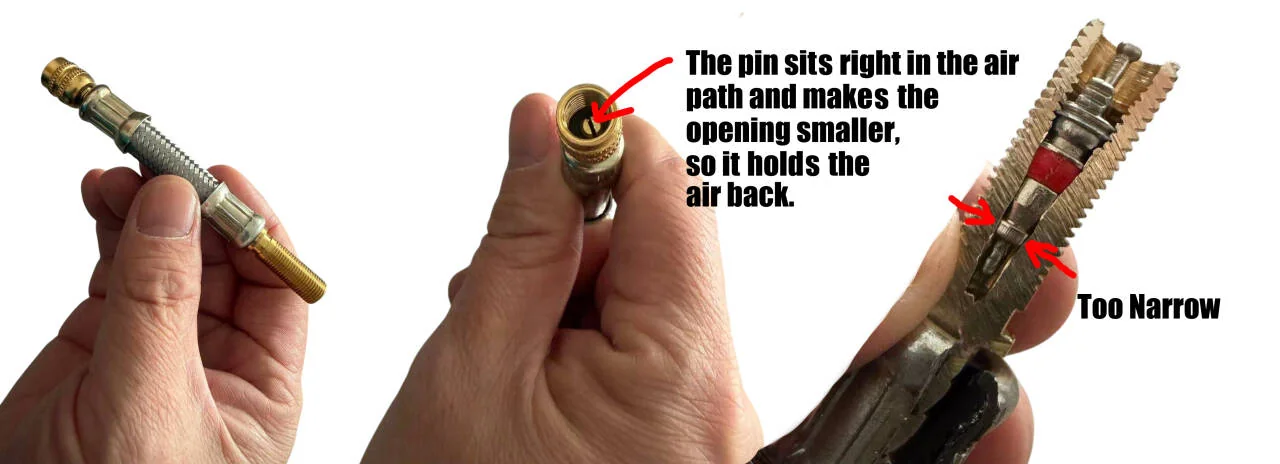
- Check the core chamber of the extension. Valve extensions are not built to a common standard, and some are made without the wider chamber around the valve core (like the one below), so the air cannot flow out freely.
- Choose an extension without a pin at the end for pressing a valve core. With the original core removed, the pin has nothing to press; the pin and the part that holds it sit right in the air path and make the opening smaller.
- Keep an open air path of about 3 mm inside.
Rapid deflation valves work the same way: a rapid deflation valve has its own valve core in a chamber wide enough for the air to flow freely, and fitted with the original valve core removed, it bypasses a narrow core chamber in the valve stem below it. In our test, both rapid deflation valves stopped at 20 to 21 PSI (see Types of Tire Deflators).
Frequently Asked Questions
Why should each wheel have its own tire deflator?
Three reasons. The error is smallest, because every valve stem is a little different and a deflator calibrated on its own wheel has that valve stem built into its correction. When one wheel is off, you know straight away where to look. And if you run different pressures front and rear, each deflator keeps its own setting.
Why do my tires end up at different pressures with the same deflator setting?
The valve stems can be different. In our test, the same automatic deflator set to 20 PSI left the tire at 19.5 to 26 PSI depending on the valve stem. Using one deflator per wheel, each calibrated on its own wheel, builds this difference into each correction.
One wheel always ends higher than the others with the same deflators. Is a deflator faulty?
Swap that deflator with one from another wheel and run them again. If the higher result stays with the wheel, the valve stem is the cause; if it moves with the deflator, check the deflator. In our tests, the valve stem alone changed the result by up to 6.5 PSI.
My friend's deflators are accurate on his vehicle. Why do they end higher or lower on mine?
The correction on each deflator was set on his valve stems, with his gauge. Your valve stems can be different, so the same deflator can stop higher or lower on your wheels. Calibrate them on your own wheels with your own gauge.
Do I need to remove the valve core to use an automatic deflator?
No. On a normal valve stem, the deflator presses the valve core open. Remove the original valve core only when you fit a valve extension or a rapid deflation valve on top of it.
Will a new valve core fix a deflator that stops high?
Usually not. Valve cores are standard parts; the difference comes from the size of the chamber the valve core sits in.
Does a TPMS valve stem affect an automatic tire deflator?
Not much in our test: the TPMS valve stem stopped at 19.5 to 20 PSI with the deflator set to 20 PSI, because its core chamber has the standard wider section around the valve core seal.
Do I need to recalibrate after changing a valve stem?
Check the correction again after changing a valve stem, a valve core or a valve extension. In our tests, valve stems of the same model that are within the standard can still differ by 0 to 2 PSI, and an out-of-tolerance valve stem can differ more.
Can I use a valve extension with an automatic tire deflator?
Yes, if the air can flow freely. Remove the valve core from the original valve stem, choose an extension without a pin at the end, and keep an open air path of about 3 mm inside. Most important, the chamber where the valve core sits must be made to the standard.
Does the length of the valve stem matter?
Very little in our quick test. The narrowest point in the air path matters much more than the total length.