
How to Choose an Automatic Tire Deflator: 6 Things to Check
Last updated:
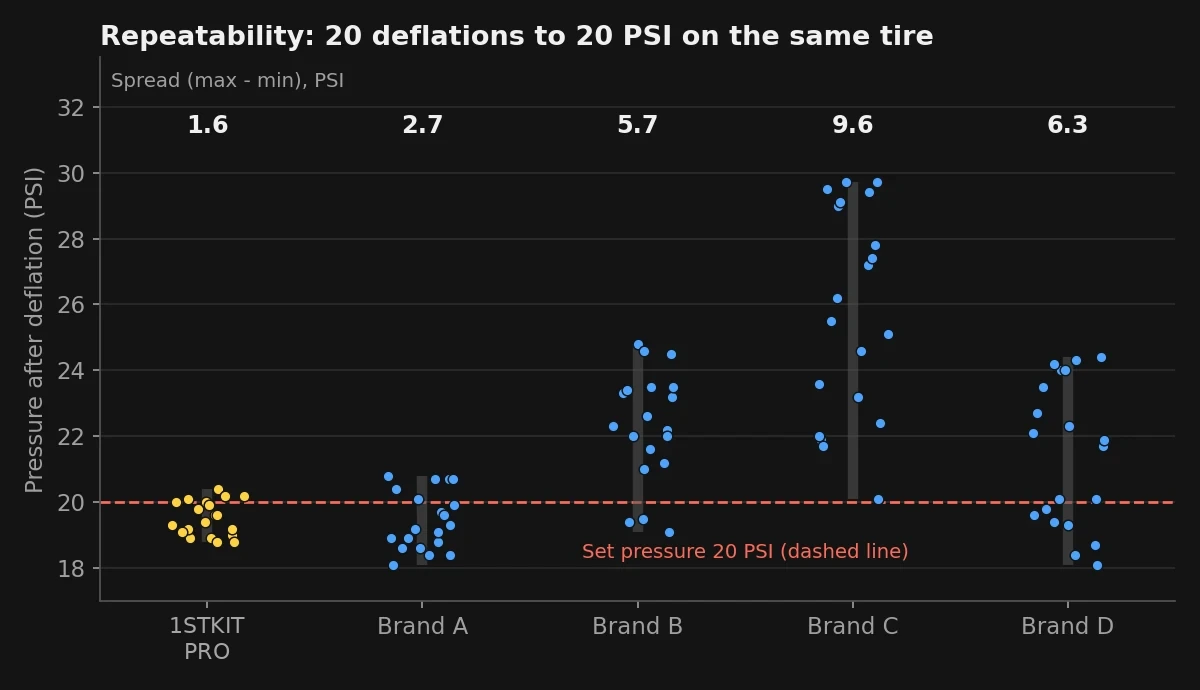
Check six things: repeatability (same result every time), accuracy (and whether you can calibrate it), shut-off (does it fully stop), air release rate, build quality and pressure range. Repeatability comes first, because a deflator that gives a different result every time cannot be corrected. In our test, deflators from five different brands, all set to 20 PSI, had a spread of 1.6 to 9.6 PSI over 20 runs each.
Most automatic tire deflators look alike: a small metal body, a spring, a plunger and a scale. On the trail they can behave very differently. One stops at 20 PSI every time. Another stops anywhere between 18 and 24. A third never quite closes and leaves you at 15.
There is no single best automatic tire deflator for everyone, but there are six things that separate a good one from a bad one. This guide covers each of them, with our own test results.
1. Repeatability: The Same Result Every Time
Repeatability is how much the final pressure changes from one run to the next with the same setting. It is the most important number to look at.
Why it comes first: if a deflator is always 2 PSI high, you correct it once and forget it. If it lands anywhere in a 6 PSI window, no setting fixes that, and your four tires end up at four different pressures.
Our test: automatic deflators from five different brands, all set to 20 PSI, each run 20 times on the same tire, refilling the tire between runs and reading every result with the same digital tire gauge, at a lab temperature of 23 plus or minus 3 degrees C (73 plus or minus 5 degrees F). Spread between the highest and lowest result:
2. Accuracy and Calibration
Accuracy is how close the final pressure is to the number you set.
Deflators with a scale are preset at the factory. Even so, the gauge you use and the model and size of your tire and valve stem can leave a difference of 0 to 4 PSI from the setting. For example, in our tests the same deflator, before calibration, stopped about 1 PSI higher on a TPMS valve stem than on a standard one, while the air release rate stayed the same. Calibrating once on your own tires takes care of this.
On 1STKIT deflators, the correction is made with the auxiliary scale. Example: you set 20 PSI and your gauge reads 22.5 PSI. Your correction is -2.5. Turn the adjustment ring counterclockwise until its 20 mark lines up with -2.5 on the auxiliary scale. After that, results are typically within about 1 PSI.
Tip: write the correction on the locking cap. It stays the same for that deflator, tire and gauge, so on a new trail you just line up the new pressure with the same correction, no gauge check needed. It also lets you set the deflator back quickly after it is dropped or cleaned.
The tire only needs to start about 10 PSI above the setting to calibrate, and you can calibrate all four deflators on four tires at the same time. If you use a valve extension, calibrate with it fitted, because it changes the air path.
There is also an older kind with no scale at all. When it arrives, you have to preset each one yourself on your own tire, which takes a lot of time, and you repeat it whenever you want a different pressure. This style has largely fallen out of favor.
3. Shut-Off: It Has to Actually Stop
A good deflator closes completely at the set pressure, often with a soft pop, and the tire stops losing air. A poor one never quite seals and keeps leaking. You set 20 PSI, walk away, and come back to 15.
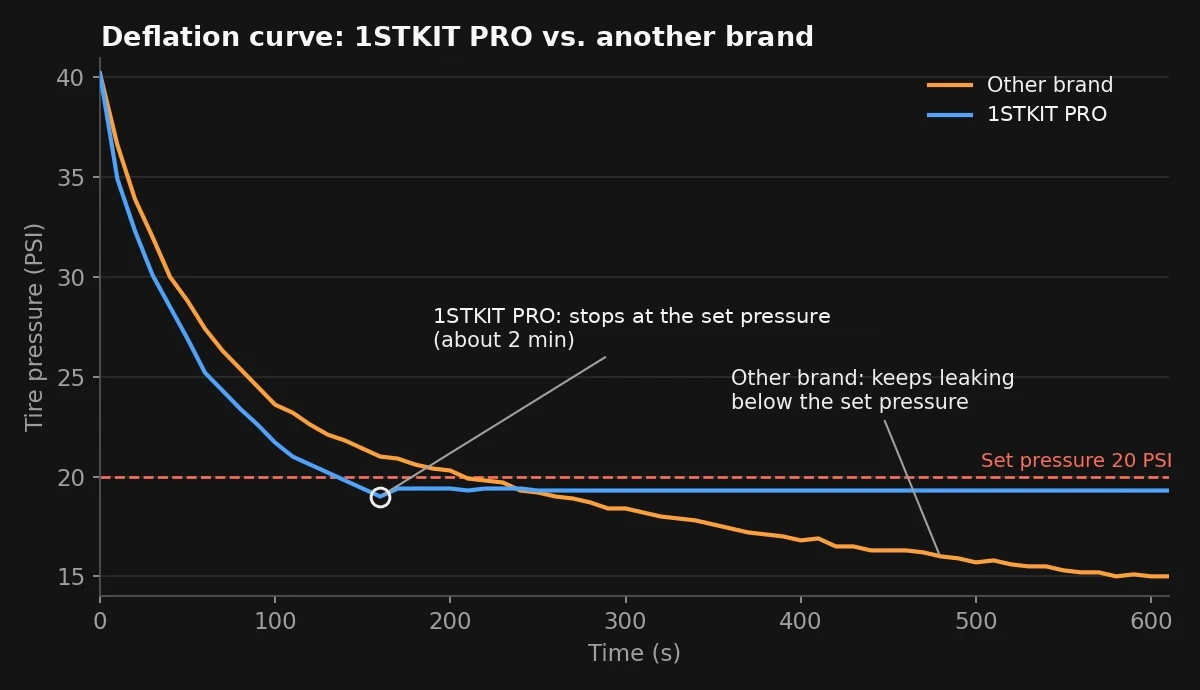
Our test: start at 40 PSI, deflator set to 20 PSI, log the pressure every 10 seconds for 10 minutes. The 1STKIT PRO (on a 32-inch tire) stopped at about 140 seconds and held at about 19.3 PSI to the end of the test (inside the normal first-use offset, which calibration removes). Another brand was still losing air at 10 minutes and finished near 15 PSI.
How to check any deflator: once it stops, leave it on for another few minutes, then read the gauge. The pressure should not have moved.
4. Air Release Rate, Tire Size and TPMS
Air release rate depends on how much air the valve passes, and on how much air is in the tire. In our tests:
| Tire (40 to 20 PSI) | 1STKIT automatic deflator |
|---|---|
| 32-inch, standard or TPMS valve stem | About 0.14 PSI/s (about 2 min 20 s) |
| 35-inch, standard or TPMS valve stem | About 0.09 PSI/s (about 3 min 40 s) |
The TPMS stem made no difference: the deflator's internal passage is smaller than a TPMS stem's, so the stem is never the bottleneck. That is not true of every air-down tool: with a rapid deflation valve on the existing stem, air release took more than twice as long on a TPMS stem.
5. Build Quality and Maintenance
Deflators are used in dusty, muddy conditions. Look for three things: a metal body that shrugs off dirt, resists oxidation and will not rust (anodized aluminum is common), good seals so it does not leak, and a plunger that dust cannot easily jam. Our deflators have anodized aluminum bodies, come in a tin case and carry a 2-year warranty. The PRO has also been through hot and cold testing (oven and freezer).
What can affect any deflator is dirt reaching the plunger, carried by the escaping air from the valve stem or the inside of the tire (for example residue after a plug repair). Most people never need to clean them, but do it if:
- it was dropped in sand, mud or water and dirt may have got into the air path: the threads that connect to the valve stem, the plunger, or the inside of the main body,
- one deflator suddenly leaves a clearly higher or lower pressure than the others, or
- the tire is 10 PSI or more above the setting, but the deflator does not start letting air out by itself when you fit it.
Keep valve caps on between trips. If a cap was missing, press the valve core briefly so the tire's own air blows the dust out before you attach the deflator.
6. Pressure Range and Hook-Up
Make sure the range covers what you actually run: 10-30 PSI suits most off-road driving, and a wider range helps with very soft sand or heavy loads. An adjustable scale lets you change pressure in seconds when the terrain changes.
Our scales read 10 to 30 PSI (PRO) and 10 to 40 PSI (Quick Connect), but with the auxiliary scale you can also set lower or higher pressures, such as 4 or 5 PSI, or above 34 PSI on the PRO. See the How to Set PSI video below.
Then choose how it connects. A screw-on deflator costs a little less. A quick-connect deflator clips on and off without threading, which is faster and easier, especially if you air down often or your hands are cold or muddy.
The connection also decides which vehicles it suits. A threaded connection holds more securely, so a screw-on deflator like the 1STKIT PRO handles a maximum working pressure of 180 PSI. That makes it suitable for tires that normally run above 60 PSI: heavy-duty pickups on Load Range E tires, RVs and motorhomes, trailers, commercial vehicles such as box, bucket and dump trucks, and heavy equipment. A quick-connect deflator is designed for tires up to 60 PSI, which covers everyday vehicles: cars, SUVs, crossovers, Jeeps, half-ton pickups and UTVs.
Our Deflators at a Glance
| 1STKIT PRO | 1STKIT Quick Connect (red or blue) | |
|---|---|---|
| Hook-up | Screws onto the valve | Press-on clip |
| Pressure scale | 10-30 PSI on the main scale, about 6-34 PSI with the auxiliary scale | 10-40 PSI on the main scale, about 6-44 PSI with the auxiliary scale |
| Max working pressure | 180 PSI (cars to heavy trucks) | 60 PSI (cars, SUVs, light pickups) |
Both models share nearly the same repeatability and the same air release rate, an anodized aluminum body, a tin case and a 2-year warranty.
Quick Checklist
- Does the maker publish repeatability and shut-off data, not just "accurate" and "fast"?
- Can you calibrate it against your own gauge?
- Does it hold pressure after it stops?
- Is the body metal, with real seals?
- Does the range cover what you run?
- Screw-on or quick-connect: how often will you hook it up, and what do you drive? Tires above 60 PSI need a screw-on deflator.
- Is there a warranty and someone who answers questions?
Frequently Asked Questions
What makes a good automatic tire deflator?
It gives nearly the same result every time, stops close to the pressure you set (or can be calibrated to), shuts off completely so the tire stops losing air, and keeps working in dust, mud and cold. In our test, deflators from five different brands, all set to 20 PSI, varied by 1.6 to 9.6 PSI across 20 runs each, so the difference between products is large.
How accurate is an automatic tire deflator?
Deflators with a scale are preset at the factory, but the gauge you use and the model and size of your tire and valve stem can leave a difference of 0 to 4 PSI from the setting. After one calibration against your own gauge, a good deflator lands within about 1 PSI.
How do I calibrate an automatic tire deflator?
Set it to your usual pressure, for example 20 PSI, and run it on a tire filled at least 10 PSI higher. Read the result with your gauge. If it reads 22.5 PSI, your correction is -2.5. Turn the adjustment ring so the 20 mark lines up with -2.5 on the auxiliary scale. Write the correction on the locking cap so you can set any pressure later without checking again.
Why does my tire keep losing air after the deflator stops?
The deflator is not sealing completely. A good one closes fully at the set pressure. If the pressure keeps dropping, remove it and check the tire. Dirt in the deflator can also cause this; cleaning it usually fixes it.
Do automatic tire deflators work on TPMS valve stems?
Yes. We tested on 32-inch and 35-inch tires with both standard and TPMS valve stems, and our automatic deflators had the same air release rate on both stems, because their internal air passage is smaller than the TPMS stem. Only tire size changed the time. Before calibration, the deflator may stop about 1 PSI higher on a TPMS stem than on a standard one; calibrating once on your own tires corrects this.
Is a quick-connect deflator better than a screw-on one?
It is faster to put on and take off, and easier with cold or muddy hands. A screw-on deflator costs a little less. Both stop at the set pressure the same way, so choose by how often you air down and what you drive: a quick-connect deflator is for tires up to 60 PSI, while a screw-on deflator handles up to 180 PSI for heavy-duty pickups, RVs, trailers and commercial vehicles.
Do I still need a tire pressure gauge?
Yes. Use it to calibrate the deflators once and to check the result. If your vehicle has a TPMS that shows the pressure of each tire, you can use that instead. An automatic deflator saves time; it does not replace the gauge.